Leadership Under Pressure: Lessons from the US Election, AI Surge, and Europe’s New Sustainability Mandate
New month, new layers, new thoughts. October 2024 marked a pivotal moment for global leaders. In three key areas, geopolitics, artificial intelligence, and sustainability regulation, executives face new challenges that require vision rather than mere tactics.
The upcoming US presidential election between Donald Trump and Kamala Harris is reshaping transatlantic relations, leading European leaders to reconsider their autonomy in the Middle East and elsewhere. At the same time, global investment in AI reached record levels, putting pressure on policymakers to strengthen governance frameworks. Additionally, the European Union made a significant move towards enforceable sustainability with the launch of the Ecodesign for Sustainable Products Regulation (ESPR) and the framework for Digital Product Passports.
Three different layers, partly interwoven, let’s dive in:
Layer 1: US Election and Europe's Strategic Autonomy: A New Era of Realpolitik
As the US presidential election approaches on November 5, 2024, the effects on American foreign policy, especially in the Middle East, are becoming clear. Analysts on both sides of the Atlantic expect a change in U.S. engagement in the region, no matter who wins. The leading candidates, Kamala Harris and Donald Trump, may have different approaches but could agree on certain military commitments while preserving security influence. From my point of view, it will be interesting to see which agenda would be followed under Trump, as he is a strong supporter of Israel and hardliner against Iran. October 7, 2023 will be a driver of his actions in the Middle East, if he wins the election.
In response, Europe is speeding up plans for strategic autonomy that have long been discussed. The EU is now more focused on defense cooperation, trade diplomacy, and crisis response. Ok, we all know: at least 20 years too late, but hope is the last to die.
The European Council's October 2024 conclusions highlighted a need for "greater operational capacity for autonomous action" in regional conflicts, especially after the geopolitical fallout from the October 7, 2023, Israel-Hamas war.1
Strategic takeaway:
Executives should prepare for a future where Europe takes on more responsibility for regional security and trade structures. Companies involved in energy, defense, or critical infrastructure need to keep a close eye on EU defense spending and foreign policy tools like the European Peace Facility and Coordinated Maritime Presence.
My bet is, that the defense topic will be surging when Trump wins as he can be called anti-NATO. With an autocracy on the Eastern flank of Europe, more autonomy and defensive capabilities of the EU might be a good idea. So, the defense industry is a business opportunity.
Layer 2: Global AI Investment and Governance Pressure Collide
In 2024, investment in artificial intelligence from the private sector reached new heights. The Stanford AI Index 2024 reports that private AI investment in the U.S. hit significant levels, with funding for generative AI rising to $25.2 billion in 2023, almost eight times higher than in 2022.2 This surge in funding has outpaced existing regulatory frameworks, increasing the pressure on global institutions to develop scalable governance models.
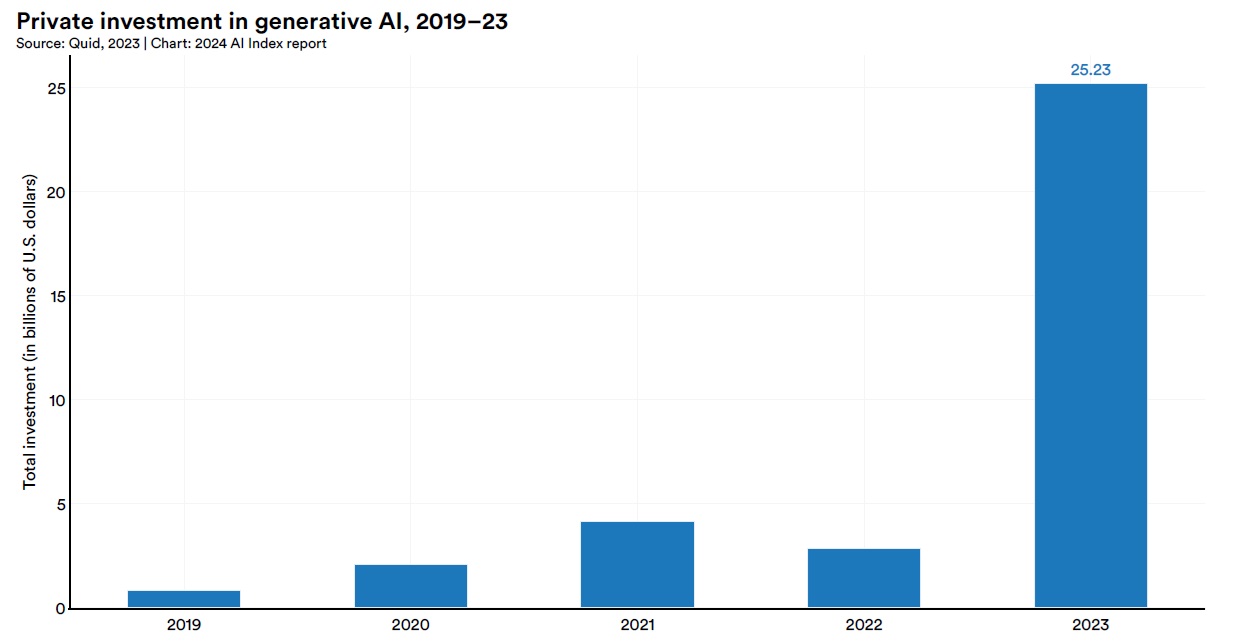
Image source: AI Index Report 2024.
The OECD AI Policy Observatory and the European Commission have intensified their calls for frameworks focused on transparency, bias reduction, and security by design. The UN Secretary-General's Advisory Body on AI Governance is working on consensus guidelines for international cooperation.
The Advisory Body on AI released its final report outlining a blueprint for addressing AI-related risks and sharing AI's transformative potential globally3. The report emphasizes the need for inclusive, agile, and effective international AI governance architecture.
Strategic takeaway:
The window for regulation is closing. Companies should start integrating AI governance into their enterprise risk strategies now, rather than waiting for official legislation. Voluntary compliance with initiatives like the AI Risk Management Framework (NIST) or the EU's AI Act (which was finalized in 2024 and is awaiting enforcement) can serve as both protective measures and reputational benefits.
Layer 3: ESPR and the Digital Product Passport: A Quiet Revolution in Sustainability Enforcement
On July 18, 2024, the EU's Ecodesign for Sustainable Products Regulation (ESPR) officially began4, but it was in October when many executives began to grasp its full strategic impact.
Central to the ESPR is the Digital Product Passport (DPP), a digital identity system that will hold verifiable information about each product's environmental profile. The DPP framework is in place, though mandatory adoption for sectors like electronics, textiles, and furniture will gradually roll out between 2026 and 2030. The DPP will enable regulators, suppliers, and consumers to confirm recyclability, repairability, and supply chain integrity. This is huge, but also implies huge implementation efforts that will have to be realised.
The regulation also includes rules against destroying unsold goods, particularly textiles, and imposes transparency requirements on product-level sustainability performance.
Strategic takeaway:
This regulation marks a shift from broad ESG reporting to more detailed accountability. Companies need to rethink compliance as a built-in system that is automated, traceable, and accessible. Digital transformation efforts in manufacturing, logistics, and ERP must now integrate product lifecycle information to maintain access to the EU market. From my point of view, it is an initiative with “good motives”, but to implement this and the other upcoming sustainability regulations into the entire European economy will potentially harm the economic growth ratios.
Conclusion
October 2024 showed that complexity has become the norm, yet it also proved that clarity is achievable. Strategic uncertainties in defense, technology, and sustainability do not require absolute knowledge. Instead, they need foresight, structure, and humility. We as leaders do not just have the role of predicting changes, but about building resilience at every level. Structural, digital, and ethical.
From geopolitical independence to AI governance to detailed ESG enforcement, the signs point to one thing: this is not a time for small steps, no matter if you are focused on a regional market or operating globally, it will impact you, trust me on this. It is a moment for strong leadership that earns trust in the boardroom, attracts innovative talent, and drives influence beyond financial results.
Sources
- European Council, "Conclusions on EU Strategic Autonomy," October 2024.
Available at: https://www.consilium.europa.eu/en/press/press-releases/2024/10/17/european-council-conclusions-on-strategic-autonomy/ - Stanford Institute for Human-Centered Artificial Intelligence, "Artificial Index Report 2024," 2024.
Available at: https://hai.stanford.edu/ai-index/2024-ai-index-report - UN Secretary-General's High-level Advisory Body on Artificial Intelligence, "Governing AI for Humanity," September 2024.
Available at: https://sdg.iisd.org/news/secretary-generals-advisory-body-makes-proposals-to-govern-ai-for-humanity/ - European Commission, "Ecodesign for Sustainable Products Regulation enters into force," July 18, 2024.
Available at: https://ec.europa.eu/commission/presscorner/detail/en/ip_24_3891
Disclaimer
To be completely transparent: writing about AI while claiming not to use AI in the content generation process would be dishonest. Therefore, this article was developed with AI-assisted support for source research, quote verification, SEO optimization, and formatting. However, all core ideas, insights, and strategic perspectives are my own original thinking and reflect my personal views as the author.