Thoughts & Layers Blog
The world is full of layers, and here are my thoughts.
Geopolitics, AI, Leadership and others key topics: these aren't separate conversations. They're interconnected layers of the same onion, each one shaping and being shaped by the others. I follow these interdependencies closely and try to provide my view for you from a C-level perspective because the patterns become clear only when you look at them together. This blog is where I share my strategic thoughts on the layers that matter most for executive decision-making.
Choose a layer, read my thoughts.
All Layers AI Leadership Digital Transformation Geopolitics Sustainability
2026 2025 2024
-
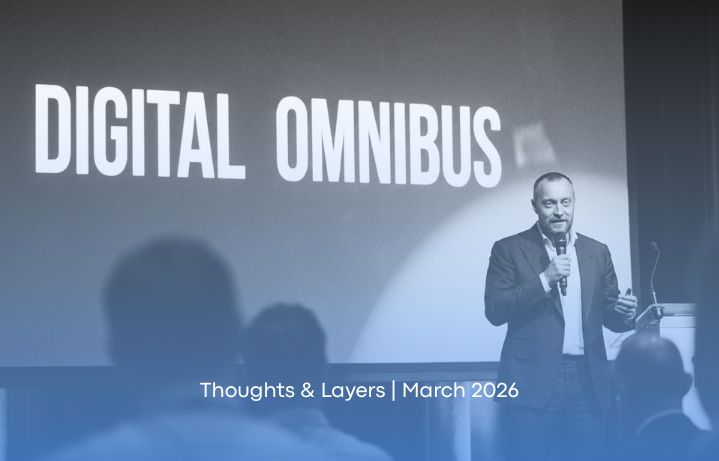
March 2026: The Infrastructure Behind AI Is Not Ready
March 2026
Four March signals converge on one conclusion. The EU delayed its own AI Act enforcement. Enterprise agent pilots cannot scale to production. Boards lack the AI oversight investors now expect. And companies are using AI as a convenient label for workforce cuts driven by financial logic, not demonstrated capability. The infrastructure behind AI is not ready.
Read my thought -
February 2026: AI Is No Longer a Technology Question
February 2026
Three February signals draw one conclusion. The EU AI Act compliance clock shifted. Forrester confirmed that AI investment is not converting to profit at scale. And Meta tied employee performance reviews to AI usage for the first time. The governance gap, the ROI gap, and the workforce gap are not separate problems. They are the same structural challenge viewed from three angles.
Read my thought -

January 2026: Systems, Standards, and Strategic Clarity
January 2026
The opening weeks of 2026 reveal observable shifts reshaping competitive dynamics: AI transitions from tools to infrastructure, protocol selection compounds faster than market recognition, and institutional strength increasingly determines execution capacity. At Davos, strategic clarity under pressure proved more valuable than diplomatic deflection. In technology markets, the Model Context Protocol achieved de facto standard status. Across sectors, the advantage shifts to organizations that integrate strategic clarity, system design, and institutional capability.
Read my thought -

December 2025: Beyond the Numbers: The Year-End Review That Actually Matters
December 2025
As 2025 closes, most organizations rush through perfunctory year-end reviews, checking boxes on KPIs while missing the deeper insights that could transform 2026. The real value lies not in celebrating what went right or cataloging what went wrong, but in understanding the organizational patterns that emerged, the capabilities that proved critical, and the strategic assumptions that need revisiting before the next cycle begins.
Read my thought -

November 2025: From Decision to Delivery: Why Strategy Now Fails or Succeeds in Execution
November 2025
By November 2025, the strategic phase is over. Capital has been allocated, priorities approved, and organizations are expected to deliver. This is where many strategies falter, not because they were misguided, but because organizations lack the capacity to execute them. Leadership credibility now shifts from decision quality to delivery capability.
Read my thought -

October 2025: Capital Allocation in Europe's Age of Constraint
October 2025
By October 2025, strategy stops being conceptual. Budgets are finalized, investment committees convene, and capital allocation decisions become irreversible. In Europe's constrained environment, capital allocation is the most explicit expression of leadership intent. The hardest decisions are not about where to invest, but where to stop.
Read my thought -

September 2025: AI Governance, Trade Complexity, and Supply Chain Accountability Enter the Boardroom
September 2025
By September 2025, AI governance, trade adaptation, and supply chain due diligence have become active board responsibilities with real legal and financial consequences. The shift is driven not by new regulation, but by enforcement. As the EU AI Act takes effect and trade uncertainty persists, accountability for compliance failures moves decisively into the boardroom.
Read my thought -

August 2025: Global Trade Realignment, AI’s Systemic Impact, and Supply Chain Resilience
August 2025
August 2025 marks a pivotal moment in the global economy. AI regulations, trade tensions, and supply chain diversification converge to reshape competitiveness. The constant: resilience and adaptability. Organizations that master regulation, responsibly integrate technologies, and build flexible systems are securing long-term advantage in an increasingly fragmented landscape.
Read my thought -

July 2025: Trade Diplomacy, National AI Ambitions, and the Enterprise Reset
July 2025
In July 2025, trade policy, technological ambition, and enterprise transformation converged around competitiveness. The U.S. advanced a comprehensive AI Action Plan, while Europe and America pursued trade negotiations to reduce uncertainty. At the same time, enterprises worldwide accelerated workforce reconfiguration, embedding artificial intelligence as a central operating force.
Read my thought -

June 2025 Strategic Outlook: Fragile Growth, Europe’s Green Trade Reset, and U.S. AI Regulation Freeze
June 2025
June 2025 underscored paradoxical dynamics: technology and green policy advanced, yet macroeconomic fragility persisted. The OECD warned of eroding resilience from policy uncertainty and weak confidence. Brussels simplified its Carbon Border Adjustment Mechanism to balance climate goals with competitiveness, while Washington advanced a 10-year moratorium centralizing AI oversight under federal authority.
Read my thought -

May 2025 Strategic Imperatives: Transatlantic Trade Friction, AI Governance Clarity, and the AI Talent Arms Race
May 2025
May 2025 marked a turning point: the U.S. threatened 50% tariffs on EU goods, Brussels opted for cautious dialogue, OpenAI reaffirmed nonprofit control under scrutiny, and AI talent wars escalated with record pay. For CEOs, resilience now hinges on trade foresight, governance clarity, and human capital strategy.
Read my thought -

April 2025 CEO Brief: EU Reporting Delay, Eurasia, U.S. Minerals
April 2025
April 2025 confirmed that competitiveness, resilience, and sovereignty anchor global leadership. Brussels delayed core sustainability rules. In Samarkand, the EU–Central Asia Summit pledged $13.2 billion for infrastructure, energy, and tech. Washington launched a “Manhattan Project” for critical minerals, committing unprecedented resources to reduce dependence on China.
Read my thought -

March 2025 Update: EU's AI Compliance Timeline, China's Global CEO Diplomacy, and India's Semiconductor Leap
March 2025
March 2025 showed how regulation, geopolitics, and industrial ambition shape the CEO agenda. Europe advanced AI Act compliance, China courted global CEOs while balancing U.S. rivalry, and India backed Tata’s Gujarat chip fab. Together, these moves underscored the need for foresight, diplomacy, and supply chain diversification.
Read my thought -

February 2025 Strategic Crossroads: EU Omnibus, AI Action, and Semiconductor Resilience
February 2025
February 2025 marked Europe’s strategic reset: the Omnibus Initiative eased ESG reporting burdens, InvestAI committed €200B to AI infrastructure, and Infineon’s Dresden Megafab secured EU approval. Together, these moves signal Europe’s intent to simplify rules, scale technology, and secure semiconductors, reshaping the agenda for CEOs in 2025.
Read my thought -

January 2025 Strategic Realignment: Europe’s Compass, America’s AI Bet, and Semiconductor Tensions
January 2025
January 2025 set the year’s tone: the EU launched its Competitiveness Compass to strengthen economic and tech leadership; the U.S. unveiled the $500B Stargate AI infrastructure project with OpenAI, SoftBank, and Oracle; and Washington raised tariffs on Chinese semiconductors to 50%, exposing fragile global technology flows.
Read my thought -
December 2024 Strategic Inflection: Europe’s Strategic Reset, AI’s New Era, and Supply Chain Shock Signals
December 2024
December 2024 consolidated three forces shaping the 2025 CEO agenda: Europe’s push toward strategic autonomy through 2029, U.S. import surges and a Section 301 probe into Chinese semiconductors highlighting supply chain stress, and OpenAI’s “12 Days of Shipmas,” unveiling generative video and advanced reasoning AI models.
Read my thought -
November 2024 CEO Briefing: US Election Shockwaves, Tariff Risks, and AI in Infrastructure
November 2024
Trump’s re-election, new U.S. AI rules for critical infrastructure, and looming tariff shocks are reshaping the global business landscape. November 2024 showed how geopolitics, technology, and trade collide. CEOs must strengthen foresight, governance, and supply chain resilience, or risk being unprepared for the turbulent years ahead.
Read my thought -

Leadership Under Pressure: Lessons from the US Election, AI Surge, and Europe’s New Sustainability Mandate
October 2024
October 2024 marked a pivotal moment for global leaders. In three key areas, geopolitics, artificial intelligence, and sustainability regulation, executives face new challenges that require vision rather than mere tactics. Especially the upcoming US presidential election is reshaping transatlantic relations, leading European leaders to reconsider their autonomy worldwide.
Read my thought -

Geopolitical Upheaval, AI Governance, and Hyper-Automation: How Executives Must Lead Through Strategic Volatility
September 2024
The executive landscape is being reshaped by three powerful, interconnected forces: persistent democratic turbulence, the accelerating push for AI governance, and the deepening of hyper-automation. These are not isolated developments. They form a volatile triangle that is fundamentally redefining how organizations approach resilience, leadership, and long-term value creation.
Read my thought