January 2025 Strategic Realignment: Europe’s Compass, America’s AI Bet, and Semiconductor Tensions
As we step into 2025, it is already clear that this year will demand clarity, resilience, and foresight from every executive navigating a rapidly shifting world. Happy New Year!
January 2025 opened with decisive moves that set the tone for the year ahead. In Brussels, the European Commission presented its Competitiveness Compass, a long-term roadmap designed to restore the EU’s economic strength and global technology leadership. In Washington, the White House unveiled the Stargate Project, a landmark $500 billion AI infrastructure initiative in partnership with OpenAI, SoftBank, and Oracle. Meanwhile, global supply chains faced a shock as the U.S. increased tariffs on Chinese semiconductor imports to 50%, underscoring the fragility of critical technology flows.
These three developments are not isolated. They form a connected strategic landscape—one where competitiveness, technological power, and supply chain resilience define the levers of 2025 leadership. For CEOs, the question is no longer whether to adapt but how to integrate responses across markets, industries, and governance systems.
Layer 1: Europe’s Competitiveness Compass: A New Industrial Horizon
On January 29, 2025, the European Commission launched its Competitiveness Compass—a strategic initiative aimed at strengthening productivity, innovation, and resilience across the Union1.
The Compass highlights:
- Productivity gaps: EU productivity growth lags the U.S. and Asia, requiring targeted reforms.
- Tech leadership: Focus on AI, semiconductors, and clean technologies as strategic industries.
- Regulatory balance: Simplification of rules to reduce burdens while maintaining social and environmental standards.
- Capital mobilization: Encouraging private and public investment in advanced infrastructure and innovation ecosystems.
Politically, the Compass is Europe’s counterweight to Trump’s America First. It signals that Europe aims to avoid dependency by fostering its own industrial and digital sovereignty.
For CEOs, this is both an opportunity and challenge: the EU’s framework will shape funding flows, regulatory design, and competitive landscapes in sectors from energy to digital services.
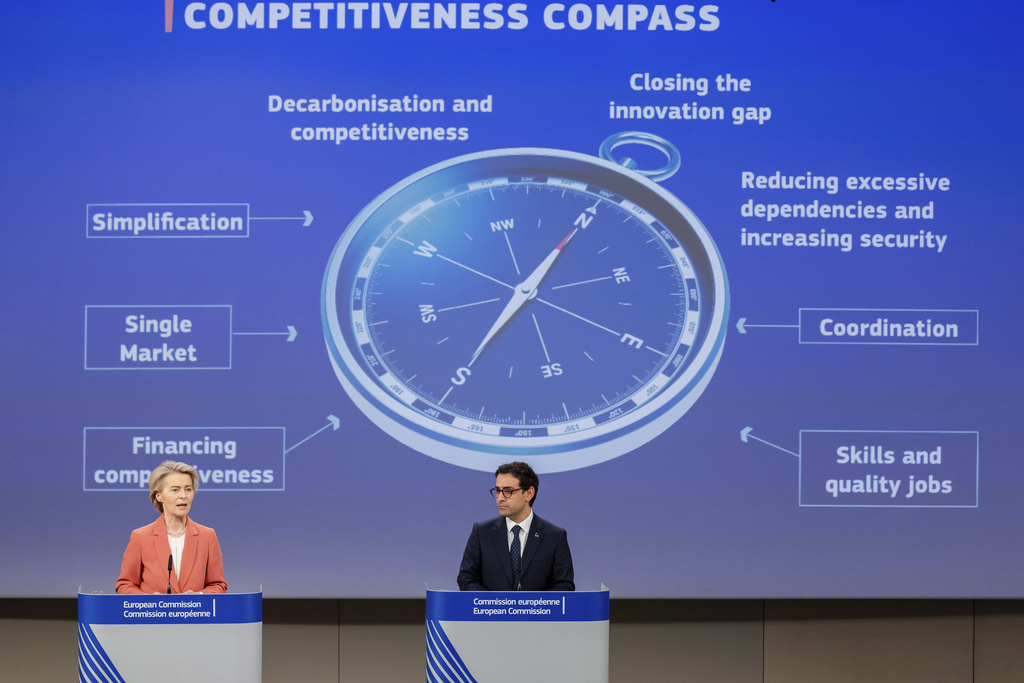
Image source: AP | Geert Vanden Wijngaert.
I highly recommend to be aware of upcoming funding opportunities from EU budgets. The union will push innovation cases and provide finance programs.
Strategic takeaways:
- Position early in EU flagship initiatives: Align with Compass priorities (AI, semiconductors, clean tech) to capture first-mover advantages.
- Build compliance efficiency: Regulatory simplification reduces friction—but requires proactive adaptation to new EU-wide benchmarks.
- Anticipate capital incentives: Leverage EU funds and blended finance programs to co-fund innovation and scale-up projects.
Layer 2: The Stargate Project: America’s $500B AI Infrastructure Bet
On January 21, 2025, the White House unveiled the Stargate Project, a joint venture between OpenAI, SoftBank, Oracle, and U.S. government agencies2 | 3.
- Scale: $500 billion planned investment over four years, the largest AI infrastructure program in history.
- Purpose: Develop hyperscale compute facilities, secure cloud platforms, and national AI infrastructure.
- Strategic goal: Cement U.S. leadership in AI capacity against rising Chinese and European competition.
- Public-private fusion: Blending state security imperatives with private sector execution and global capital.
The project reflects a strategic pivot: AI infrastructure is no longer a corporate differentiator but a national capability. It echoes the Cold War’s space race, with AI compute power now treated as the 21st-century equivalent of nuclear deterrence.
For CEOs, Stargate sets a new standard for scale. Access to infrastructure will influence innovation capacity, partnerships, and competitive positioning.
Strategic takeaways:
- Audit AI dependencies: Map reliance on U.S.-based compute providers and anticipate costs and restrictions.
- Engage in ecosystem partnerships: Align with AI infrastructure consortia to secure access and relevance.
- Scenario-plan global competition: Recognize Stargate as both a U.S. advantage and a trigger for EU and Asian responses.
Layer 3: Semiconductor Tensions: More Tariffs and Supply Chain Fragility
On January 1, 2025, the U.S. Trade Representative enforced a 50% tariff on Chinese semiconductor imports. This move targeted “legacy chips”: older but vital semiconductors used in automotive, defense, consumer electronics, and industrial systems4 | 5.
- Cost inflation: Manufacturers in autos and electronics face immediate price hikes.
- Supply constraints: China dominates legacy chip production, making alternative sourcing difficult.
- Retaliation risk: Beijing may impose countermeasures on rare earths or downstream electronics.
For global businesses, the message is blunt: semiconductor geopolitics is no longer about leading-edge chips only. Legacy components—often overlooked—are now strategic choke points.
Strategic takeaways:
- Diversify suppliers: Apply “China+1” sourcing strategies to both advanced and legacy semiconductors.
- Increase inventory buffers: Build safety stock for mission-critical chips vulnerable to tariff volatility.
- Monitor policy spillovers: Expect EU and Asian responses, possibly including export controls or investment incentives.
Conclusion
January 2025 revealed three signals no CEO can ignore:
- Competitiveness is now designed, not assumed: The EU’s Compass formalizes long-term priorities, tying industrial and digital strategy to resilience.
- AI is national infrastructure: The Stargate Project elevates compute capacity to a strategic asset, reshaping global innovation dynamics.
- Supply chains are strategic battlegrounds: Semiconductor tariffs remind us that resilience requires both diversification and foresight.
The CEO’s role is no longer to react to individual events but to integrate geopolitics, technology, and supply chains into a single strategic narrative. Those who do will not just survive volatility—they will define the future operating environment.
Sources
- European Commission, “Steering the EU towards greater sustainable competitiveness,” January 29, 2025.
Available at: https://commission.europa.eu/news-and-media/news/steering-eu-towards-greater-sustainable-competitiveness-2025-01-29_en - OpenAI, “Announcing the Stargate Project,” January 21, 2025.
Available at: https://openai.com/index/announcing-the-stargate-project/ - Reuters, “EU approves €920 mln German aid for Infineon chips plant,” February 20, 2025.
Available at: https://www.reuters.com/technology/eu-approves-920-mln-euro-german-aid-infineon-chips-plant-2025-02-20/
Disclaimer
To be completely transparent: writing about AI while claiming not to use AI in the content generation process would be dishonest. Therefore, this article was developed with AI-assisted support for source research, quote verification, SEO optimization, and formatting. However, all core ideas, insights, and strategic perspectives are my own original thinking and reflect my personal views as the author.