February 2025 Strategic Crossroads: EU Omnibus, AI Action, and Semiconductor Resilience
February 2025 was a month where Europe set a new course for its competitiveness and resilience. Against the backdrop of slowing global growth and intensifying geopolitical competition, the European Commission delivered three decisions that will shape both boardroom agendas and long-term industrial trajectories.
First, the adoption of the Omnibus Initiative on February 26 signaled a new pragmatism in European sustainability policy. By simplifying reporting requirements under CSRD and CSDDD, Brussels acknowledged that regulation must enable competitiveness rather than overburden it. The move reassures businesses that sustainability remains central, but it will be implemented with sharper focus and fewer bureaucratic hurdles.
Second, at the AI Action Summit in Paris, Europe unveiled InvestAI, a €200 billion commitment to artificial intelligence infrastructure, ecosystems, and adoption. With global competitors racing ahead—China through state-driven industrial strategy and the U.S. through the $500 billion Stargate Project—InvestAI is Europe’s most ambitious attempt to close the gap and position itself as a credible player in the next technological era.
Third, the Commission approved €920 million in German state aid for Infineon’s Megafab-DD semiconductor plant, a €3.5 billion investment in Dresden, Germany, under the European Chips Act. This move reflects growing recognition that semiconductors are no longer just industrial inputs—they are strategic infrastructure, as essential as energy and defense, and a prerequisite for sovereignty in an era of trade wars and tariff escalations.
Taken together, these three decisions underscore Europe’s strategic intent: to simplify where rules have grown heavy, to invest where gaps are widening, and to build where dependencies are dangerous. For CEOs, February 2025 sends a clear signal that Europe is recalibrating its industrial model—and leadership means aligning early with this reset.
Layer 1: EU Omnibus Initiative: Simplifying Sustainability for Competitiveness
On February 26, 2025, the European Commission adopted its first Omnibus Initiative, a sustainability simplification package responding to strong criticism from businesses and investors about the rising burden of ESG regulation1.
The package includes:
- Postponement of CSRD assurance requirements for SMEs, extending deadlines.
- Simplified reporting templates to reduce duplication between CSRD, SFDR, and CSDDD obligations.
- Easing due diligence requirements for smaller companies to reduce compliance costs.
- Harmonization across frameworks to increase comparability and reduce administrative friction.
The Omnibus reflects a strategic shift: rather than layering more obligations, the Commission now emphasizes feasible compliance as a competitiveness tool. It’s recognition that Europe cannot afford to overregulate itself while competitors like the U.S. and China move faster on industrial policy.
For CEOs, this means sustainability is no less important, but its execution is becoming more pragmatic. Investors will still expect substance, but the EU is signaling flexibility in how it is delivered. For Consultants who specialized on delivering services like CSRD: it's a fricking mess.
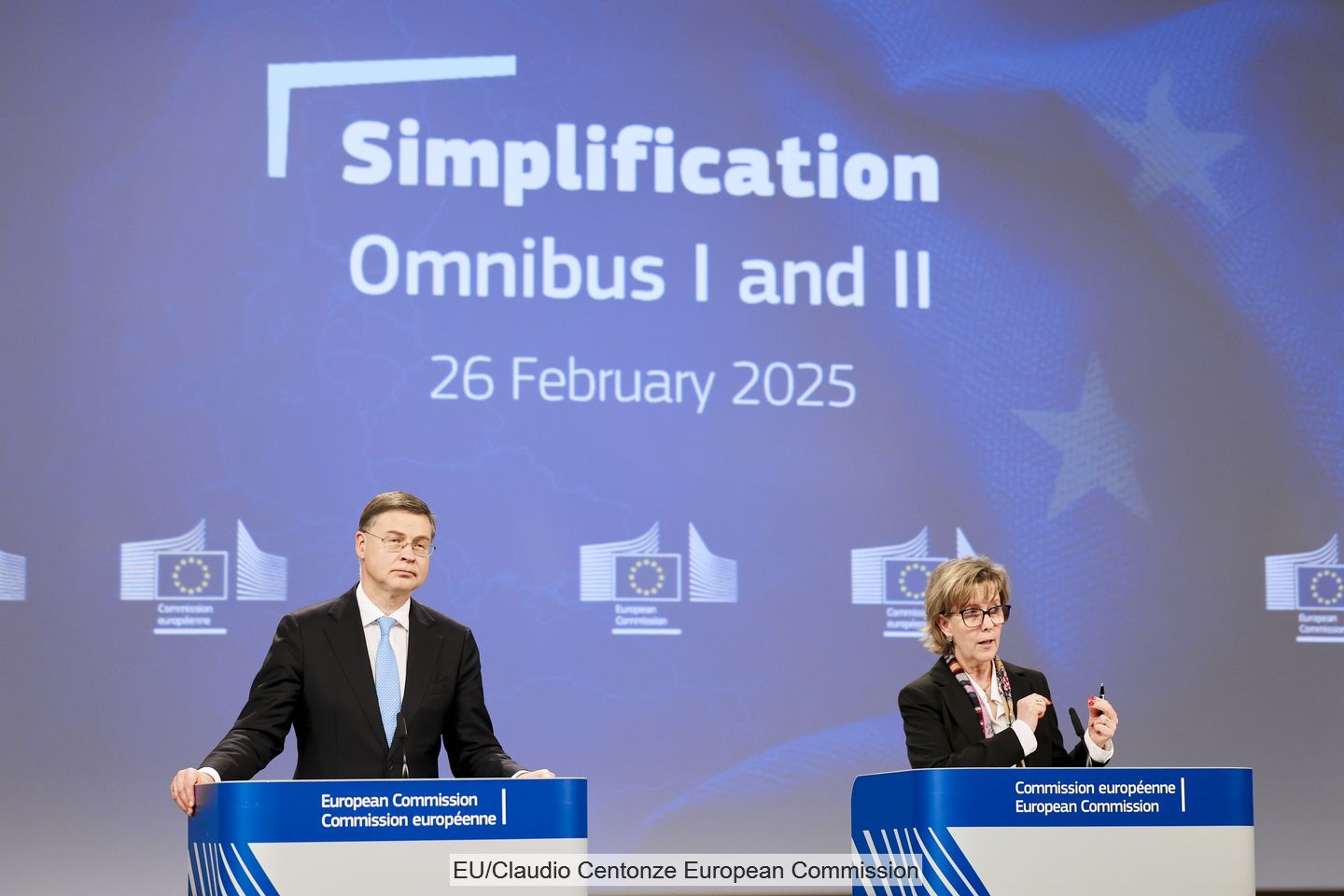
Image source: EU | Claudio Centonze.
Strategic takeaways:
- Streamline internal ESG processes: Align with simplified templates to cut reporting costs without diluting transparency.
- Anticipate phased obligations: Use the postponement period to strengthen data systems before full assurance applies.
- Reframe ESG as competitiveness: Position sustainability not as a burden but as a differentiator aligned with European policy priorities.
Layer 2: InvestAI: Europe’s €200 Billion Bet on AI
At the AI Action Summit in Paris (Feb 10–11, 2025), the European Union unveiled InvestAI, a €200 billion program designed to accelerate AI development, adoption, and infrastructure across the bloc2.
Key features of InvestAI:
- €20 billion earmarked for AI gigafactory infrastructure, creating large-scale compute facilities to reduce reliance on U.S. hyperscalers.
- SME access programs, ensuring smaller firms benefit from AI tools and don’t fall behind digital leaders.
- Focus on sustainable and trustworthy AI, aligned with the EU AI Act’s governance principles..
- International collaboration, with a Paris Declaration signed on inclusive, responsible AI.
Strategically, InvestAI positions Europe to avoid technological marginalization. It is Europe’s counter-response to the U.S. Stargate Project ($500B) and China’s state-driven AI industrial policies. It also demonstrates that Brussels recognizes AI as a general-purpose technology critical to competitiveness, not just a niche innovation field.
For executives, this means AI is no longer an experiment—it is an expectation. From manufacturing optimization to customer personalization and risk management, adoption curves will be shaped by both market forces and public-sector funding.
Strategic takeaways:
- Leverage public-private funding: Position projects to tap InvestAI capital, especially in applied AI for industry.
- Embed trust into adoption: Governance and transparency are not optional in Europe—competitive positioning depends on trustworthiness.
- Bridge the talent gap: Use InvestAI momentum to accelerate recruitment and training, ensuring readiness to deploy AI at scale.
Layer 3: Infineon’s Megafab-DD: Semiconductors as Strategic Infrastructure
On February 20, 2025, the European Commission approved €920 million in German state aid for Infineon’s planned Megafab-DD semiconductor plant in Dresden, a €3.5 billion investment under the European Chips Act3.
Key aspects:
- Focus on automotive and industrial chips—sectors where Europe has strategic demand but high import dependency.
- Integration into the Chips Act goal of producing 20% of global semiconductors in Europe by 2030.
- Public-private model: EU approval enables Germany to co-finance the project alongside Infineon’s private investment.
This approval is more than industrial policy. It is Europe’s signal that semiconductors are strategic infrastructure, as vital as energy or defense. With U.S.–China tensions escalating and tariffs disrupting legacy chip flows, Europe cannot remain dependent on foreign supply chains.
For CEOs, the implications are direct: semiconductors are a board-level risk factor, and resilience requires not just procurement agility but alignment with regional industrial strategies.
Strategic takeaways:
- Assess semiconductor exposure: Map dependency on legacy and advanced nodes—resilience starts with transparency.
- Explore European sourcing: Align with Chips Act-funded fabs as potential suppliers or partners.
- Plan for policy conditionality: Access to EU-supported chips may come with regulatory expectations on sustainability and sourcing disclosure.
Conclusion
February 2025 confirmed Europe’s determination to recalibrate its competitiveness strategy by simplifying regulation, scaling AI, and securing semiconductors.
- The Omnibus Initiative reflects a new pragmatism: sustainability must support competitiveness, not undermine it.
- InvestAI is Europe’s boldest attempt yet to ensure it remains relevant in the AI race, blending infrastructure, governance, and inclusivity.
- Infineon’s Megafab-DD underscores that semiconductors are no longer an industrial commodity but a strategic asset, central to resilience.
For CEOs, the message is clear: Europe is no longer content with playing catch-up. It is building the frameworks, funding, and industrial base to assert its sovereignty in sustainability, technology, and supply chains. Those who align early will find opportunity. Those who delay may find Europe’s strategic reset has already moved past them.
Sources
- Deloitte Legal, “The Omnibus Simplification Package Proposal Has Arrived,” February 26, 2025.
Available at: https://www.deloittelegal.be/lg/en/blogs/the-omnibus-simplification-package-proposal-has-arrived.html - European Commission, “EU launches InvestAI initiative to mobilise €200 billion of investment in artificial intelligence,” February 11, 2025.
Available at: https://luxembourg.representation.ec.europa.eu/actualites-et-evenements/actualites/eu-launches-investai-initiative-mobilise-eu200-billion-investment-artificial-intelligence-2025-02-11_en - Reuters, “Trump to announce private-sector AI infrastructure investment,” January 21, 2025.
Available at: https://www.reuters.com/technology/artificial-intelligence/trump-announce-private-sector-ai-infrastructure-investment-cbs-reports-2025-01-21/ - White & Case, “United States finalizes Section 301 tariff increases on imports from China,” September 17, 2024.
Available at: https://www.whitecase.com/insight-alert/united-states-finalizes-section-301-tariff-increases-imports-china - Center for European Policy Analysis (CEPA), “Legacy Chips: The Next Tech Battle with China,” January 24, 2025.
Available at: https://cepa.org/article/legacy-chips-the-next-tech-battle-with-china/
Disclaimer
To be completely transparent: writing about AI while claiming not to use AI in the content generation process would be dishonest. Therefore, this article was developed with AI-assisted support for source research, quote verification, SEO optimization, and formatting. However, all core ideas, insights, and strategic perspectives are my own original thinking and reflect my personal views as the author.